
In 2022, the Judiciary aims to work toward a “Justice for Today” system, as a fundamental aspect of ensuring human dignity and legal certainty through an inclusive, timely, and reliable justice system.
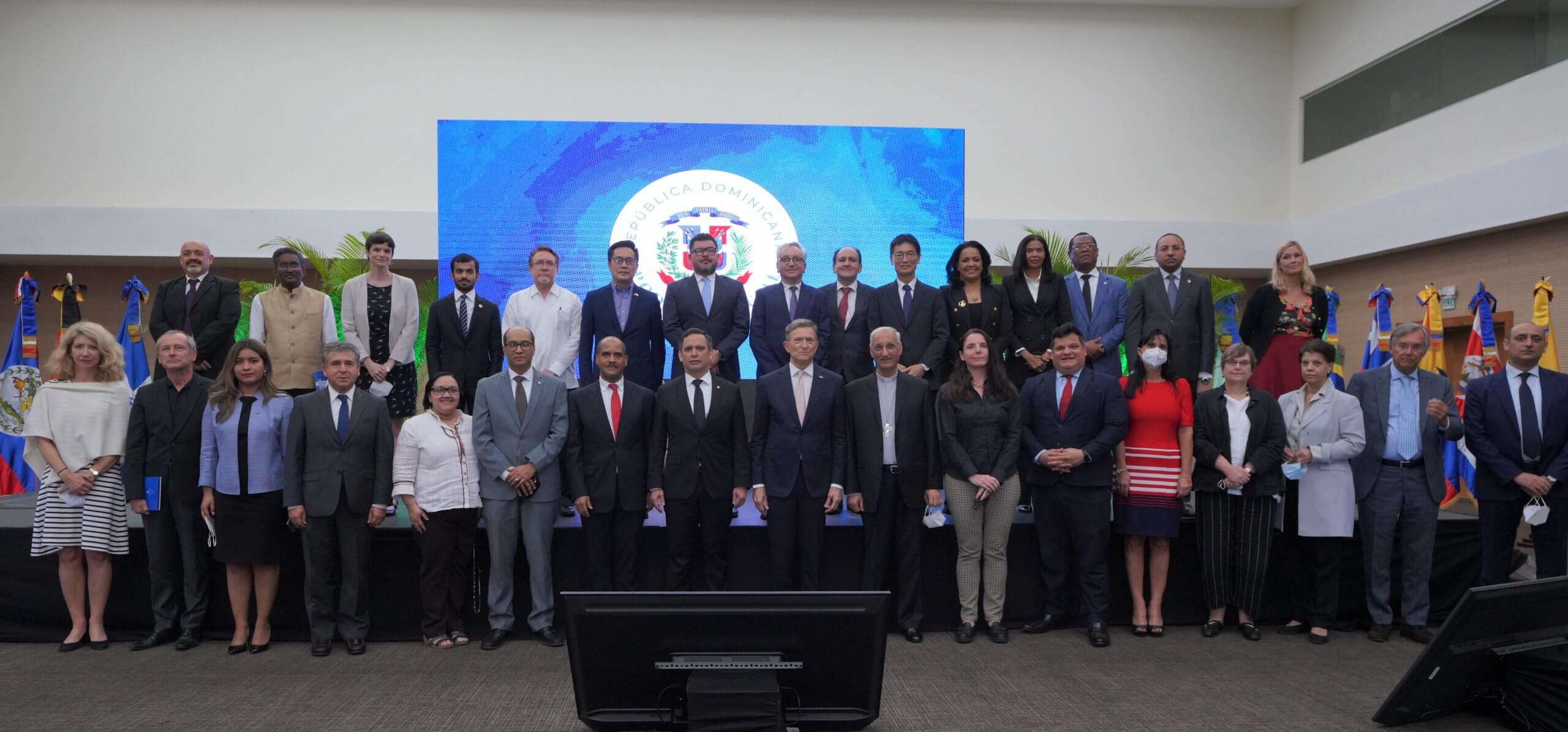
Santo Domingo de Guzmán, Dominican Republic._ The Chief Justice of the Supreme Court of Justice (SCJ) and of the Judicial Council, Luis Henry Molina Peña, and the Minister of Foreign Affairs, Roberto Álvarez Gil, led a meeting with representatives of the diplomatic and consular corps accredited in the country, to whom they presented the progress and challenges facing the Dominican justice system.
The meeting, held at the Convention Center of the Ministry of Foreign Affairs (MIREX), was primarily intended to create a forum for dialogue with diplomatic representatives from other nations and international organizations based in the country, to share with them the improvements implemented by this branch of government in an effort to ensure the quality of justice in the Dominican Republic.
In this regard, the Chief Justice of the Supreme Court of Justice (SCJ), Luis Henry Molina Peña, explained that the justice system has evolved continuously since the 1990s and now strives to meet higher standards of integrity and independence.
“To ensure that this work is carried out in accordance with the necessary requirements, the Judiciary has launched a review of all its systems, thereby updating and strengthening mechanisms that allow for the adaptation and optimization of safeguards for personal and property rights,” stated Judge Molina Peña.
In 2022, the Judiciary aims to work toward a “Justice for Today” system, as a fundamental aspect of ensuring human dignity and legal certainty through an inclusive, timely, and reliable justice system.
“To address the various challenges facing the justice system, we need access to mechanisms that optimize its management; the system must be able to rely on its stakeholders for continuous improvement, and this aspect grew considerably when, in the face of the health crisis, we had to decide to implement digital services,” explained Molina Peña.
Foreign Minister Roberto Álvarez delivered the welcoming remarks, stating that Democratic governments like ours make great efforts to strengthen their judicial systems and guarantee their independence, recognizing that the stability, tranquility, peace, and well-being of the population depend to a large extent on the proper functioning of this branch of government.
“The Government of Change” The administration led by Luis Abinader has made the strengthening of democratic institutions one of its main pillars, based on strict compliance with the legal framework, transparency, and the promotion of inter-institutional coordination, in order to implement actions aimed at fulfilling the National Development Strategy and the Sustainable Development Goals, without leaving anyone behind,” added Minister Álvarez.
During the event, which was supported by the Spanish Agency for International Development Cooperation (AECID), the implementation of tools that foster closer engagement with users of justice services and society at large was presented, along with the challenges the Judiciary will face in achieving its strategic objectives.
Justice Justiniano Montero Montero, a judge on the First Chamber of the Supreme Court of Justice, explained the bill on the Use of Digital Media in the Judiciary currently before the National Congress, whose main objective is to enable the use of digital technology in all judicial and administrative proceedings handled by the bodies of that branch of government.
Judge Martha Díaz Villafaña, president of the Civil and Commercial Chamber of the Court of Appeals of San Francisco de Macorís, addressed the topic “Institutional Perspective,” in which she summarized the Judiciary’s Strategic Plan, “Vision Justice 20/24,” and the main achievements over the past year, as well as the work carried out in 2021 at the Real Estate Registry and the National School of the Judiciary.
For his part, Judge Édynson Alarcón, president of the Civil and Commercial Chamber of the National District Court of Appeals, explained the progress made in implementing the new office automation system, which consolidates all administrative processes within that jurisdiction into a single program to save time and optimize results.
 Español
  English
  Français
  Italiano
  Deutsch
  Português do Brasil
  Polski
  Русский