
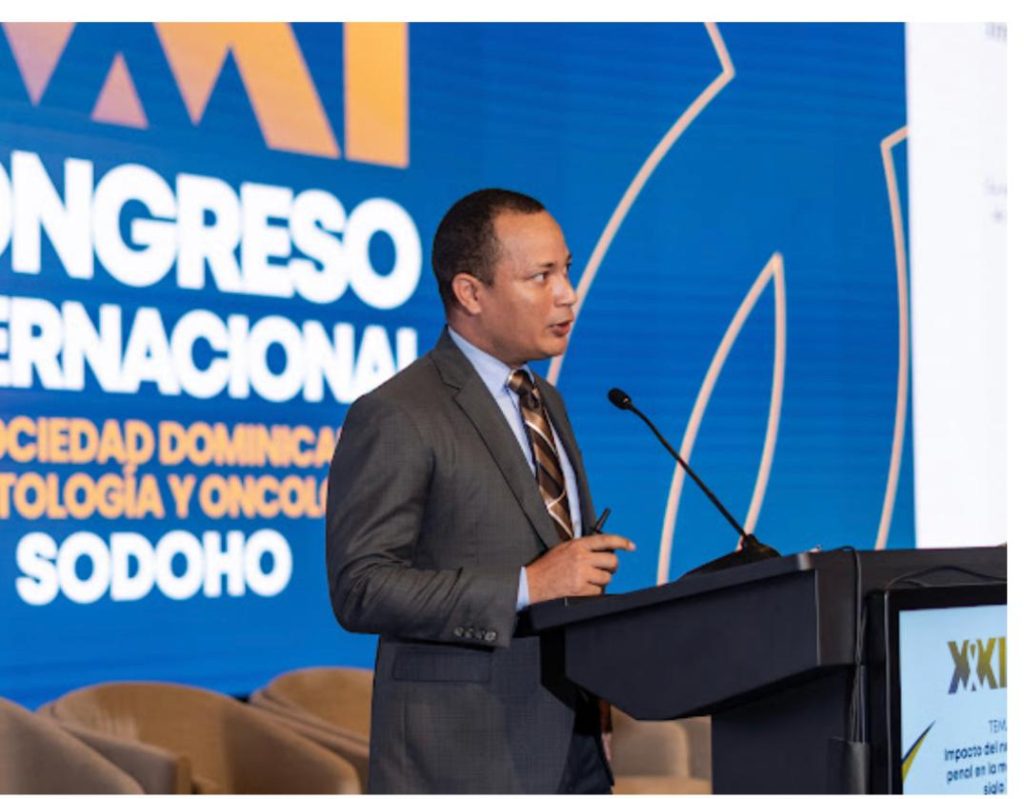
The law firm Johann Newton López & Associates is participating in the 21st SODOHO International Congress in Cap Cana
Johann Newton López & Associates participated in the 21st International Congress of the Dominican Society of Hematology and Oncology (SODOHO), held September 24–27, 2026, at the Hyatt Cap Cana Convention Center in Cap Cana, Dominican Republic.
The conference, held under the theme “Unity That Strengthens, Therapies That Transform,” brought together national and international specialists in a forum dedicated to scientific updates, the exchange of knowledge, and a multidisciplinary analysis of current challenges in hematology and oncology.
In this context, Johann Newton López & Associates contributed a legal perspective to the medical discussion through the conference “Impact of the New Penal Code on 21st-Century Medicine,” which focused on the implications of the new Dominican criminal justice system for physicians, healthcare professionals, clinics, hospitals, and medical societies.
The Law in the Face of an Increasingly Complex Field of Medicine
The transformation of medicine also requires a shift in how we understand legal liability.
The presentation was based on a fundamental premise: the legal liability of a healthcare professional does not arise from the adverse outcome itself, but rather from a possible breach of the duties of care, disclosure, and acting in accordance with the lex artis, as assessed in the specific circumstances of each case.
From this perspective, the discussion addressed the need to distinguish between an adverse medical outcome—which can occur even when professional conduct is appropriate—and those actions in which a specific breach of the duty of care could be established.
This approach is particularly relevant in light of the enactment of a Penal Code that introduces provisions capable of directly affecting the organization and delivery of health services.
The New Penal Code and the Liability of Medical Institutions
One of the central themes of the conference was the new regime governing the criminal liability of legal entities, as set forth in Articles 8 through 11 of the Dominican Penal Code.
Its implications go beyond the individual responsibility of the physician.
Clinics, medical centers, professional associations, and other organizations involved in the provision of health care services must pay particular attention to their duties of management, control, and supervision, as well as to the effective implementation of compliance and risk prevention programs.
The new regulatory landscape makes concepts such as regulatory compliance, corporate governance, document traceability, internal protocols, ongoing training, and oversight mechanisms particularly important for the legal management of healthcare institutions.
During the presentation, various areas of criminal liability related to the practice of medicine were also analyzed, including negligent endangerment of life, injuries caused by recklessness or negligence, abandonment, and the duty to render aid, biomedical experiments, informed consent, the protection of personal health data, genetic testing, assisted reproduction, and medical certifications.
Prevention also means protecting the patient
One of the key messages shared during the conference was that legal prevention should not be viewed solely as a defense mechanism against a potential claim.
An effective prevention policy contributes simultaneously to patient safety, the protection of healthcare professionals, and the institutional strengthening of clinics and medical societies.
Updated protocols, informed consent, proper documentation of medical histories, documentation of medical decisions, monitoring systems, and effective compliance programs can become essential tools for reducing risks and improving the quality of care.
In this context, the medical record takes on particular importance. The initial evaluation, the risks explained, treatment options, findings, decisions made, complications, consultations with other specialists, follow-up, and instructions given to the patient are all part of a chain of documentation that protects both the patient and the healthcare professional.
Medicine, Law, and Institutional Responsibility
Johann Newton López & Associates’ participation in the 21st SODOHO International Congress is part of a vision for the practice of law that seeks to anticipate the new challenges arising from the interaction between law, medicine, technology, and the business organization of health care services.
The new criminal justice framework presents challenges that require more than simply reacting when a conflict arises. It calls for prevention, education, and the development of institutional structures capable of identifying and properly managing risks.
The Firm will continue to promote opportunities for dialogue between legal and healthcare professionals, firmly believing that legal responsibility must contribute to an essential balance: protecting patients from unjust harm while, at the same time, preventing the criminalization of medical acts performed honestly, diligently, and in accordance with scientific principles.
Because, ultimately, a healthcare system that is more legally sound can also be a more humane, transparent, and fair one.
 Español
  English
  Français
  Italiano
  Deutsch
  Português do Brasil
  Polski
  Русский