
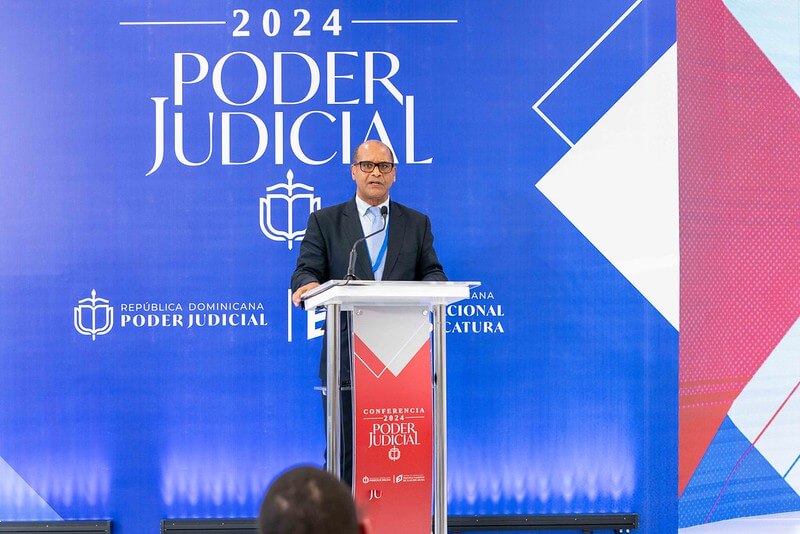
Judge Justiniano Montero, a judge on the Civil and Commercial Division of the Supreme Court of Justice (SCJ), issued the Conference on Ethics and Corruption, in which he stated that the best means of oversight in public institutions of any kind is to educate people about the moral importance of public service.
The judge, who is also a member of the Ibero-American Commission on Judicial Ethics, explained that there is a need for public policies that provide guidance on what ethics in public administration should entail, particularly as part of a systematic orientation program in each institution; Each state institution must incorporate this pillar into its strategic planning and invest in this area as a way to contribute to what are known as “soft skills.” This is not a matter of punishment but of prevention, in that upholding ethical standards is the approach that prevents acts that would otherwise constitute disciplinary offenses.
“We must raise awareness of these principles so that you put them into practice in your actions and conduct, and this way of conceiving the model of public servant performance is what is known in moral doctrine as the ethics applicable to public servants,” he explained during the conference.
Judge Montero argued that the individualism practiced by society leads to moral and functional illiteracy in terms of abilities, as reflected in the saying, “Look out for me now.” He also asserted that this behavior constitutes a lack of moral development.
“That behavior is harming you and your family—in terms of health and education—because you don’t play a critical role in society; you feel like just another damaged cell in a social body that, if it continues down this path, will develop into an ethical cancer, regardless of whether the social body reaches its terminal phase,” Judge Montero explained metaphorically, referring to the harmful nature of corrupt practices.
The judge, an academic and expert in judicial ethics, explained that this lack of moral development is particularly pronounced in Latin American and Caribbean countries.
According to the speaker, the issue of developing a model for moral education in today's societies inextricably links public ethics and good governance as essential pillars.
The talk titled “Ethics and Corruption,” held as part of the 2024 Judicial Conference, was attended by justices of the Supreme Court, as well as judges from various jurisdictions across the country, legal scholars, and foreign delegations. Members of the Institute of Higher Studies of Ibero-America—comprising five countries in the region—also attended this important event.
 Español
  English
  Français
  Italiano
  Deutsch
  Português do Brasil
  Polski
  Русский