
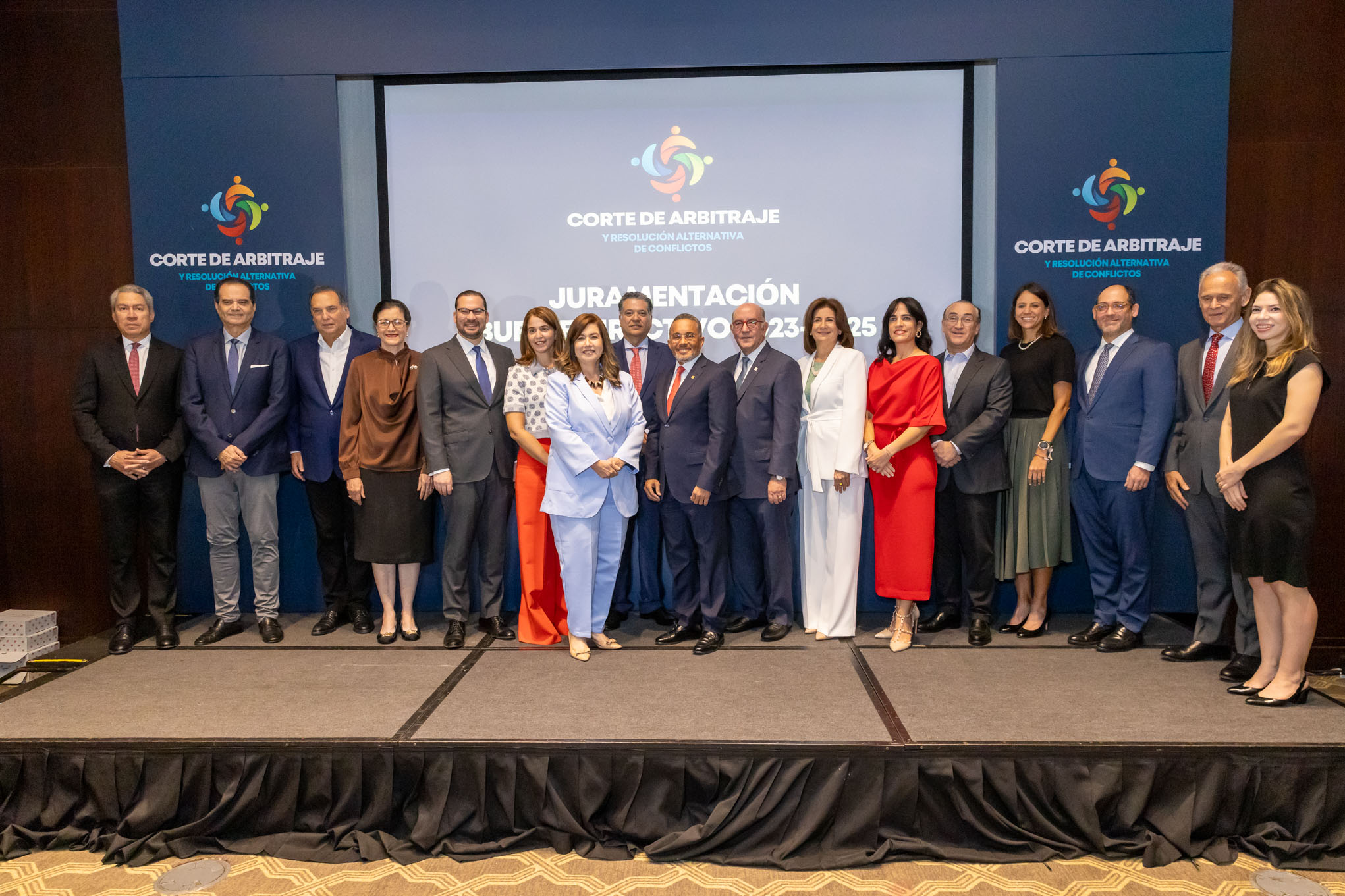
National District. The Court of Arbitration and Alternative Dispute Resolution of the Santo Domingo Chamber of Commerce swore in its new executive board for the 2023–2025 term, with Ramón Ortega serving as the new president, succeeding Eduardo Domínguez-Imbert.
The ceremony, which took place at the Intercontinental Real Santo Domingo Hotel, brought together prominent figures from the legal and business worlds.
In addition to Ortega, the new executive board is composed of 15 members recognized for their professional expertise within the business and legal communities of the Dominican Republic, including: Anyarlene Bergés, Vice President; José Luis Alonso, Treasurer; and Fernando Villanueva, Assistant Treasurer.
The board is rounded out by the following members: Luis Miguel Pereyra, Eduardo Domínguez-Imbert, Leonel Melo, Mario Lama, Marco Bisonó, Jaime Senior, Aura Fernández, Laura Medina, Carolina Soto, Karina Elmúdesi, and Rafael Dickson Morales.
In his remarks, Ramón highlighted the importance of developing arbitration in the Dominican Republic, using international practices as a model: “We must develop arbitration in the country in every way, increasing exposure to international practices that make the most of the advantages of arbitration—in particular, its flexibility in presenting cases, its ability to effectively handle both simple and complex matters, the speed with which cases are processed, and the depth and expertise of the decisions.”.
He also expressed his commitment to continuing to promote alternative dispute resolution methods as the most efficient and confidential way to resolve a dispute.
For his part, Domínguez-Imbert, the former president, expressed his gratitude for the trust placed in his leadership and, at the same time, highlighted the recent changes the Court has undergone in recent years, including the significant increase in the number of arbitration, conciliation, and mediation cases received by the Court and the institution’s name change from the Center for Alternative Dispute Resolution to the Court of Arbitration and Alternative Dispute Resolution, with the aim of reaching a wider audience.
He also noted the efficiency of arbitration, pointing out that 90 percent of these proceedings are concluded within two years or less, and the decisions are not subject to appeal, unlike in the courts. He therefore stressed the importance of the public understanding that they have this option, so that they include in commercial contracts a provision stating that, rather than going to court to resolve any disputes that may arise, they be resolved before the Santo Domingo Court of Arbitration.
In addition to the swearing-in of the new executive board, the event also served as a platform to unveil the Court of Arbitration’s new corporate identity. The updated design aims to convey the institution’s mission of offering alternative dispute resolution methods in a reliable, efficient, confidential, and flexible manner, positioning the Court of Arbitration as a cutting-edge dispute resolution platform adapted to society’s changing needs.
The ceremony concluded with a reception where guests had the opportunity to exchange ideas and forge key connections in the legal and business communities. The event was not only a celebration of past achievements but also a renewed commitment to the future of the Santo Domingo Court of Arbitration.
 Español
  English
  Français
  Italiano
  Deutsch
  Português do Brasil
  Polski
  Русский