
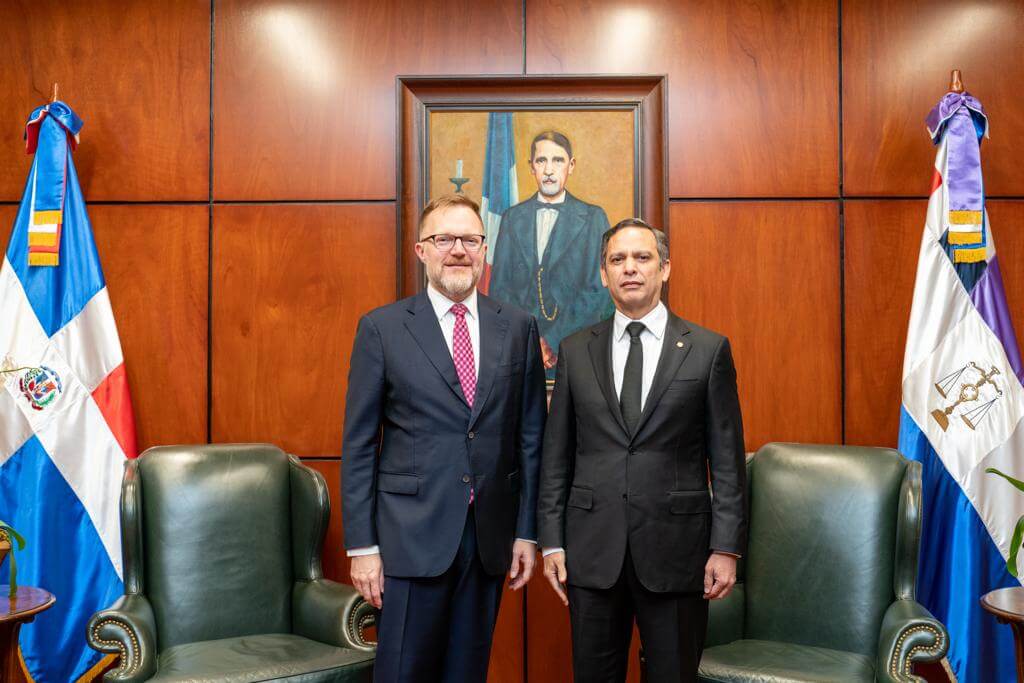
The president of the Supreme Court of Justice (SCJ) and the Judicial Council (CPJ), Luis Henry Molina Peña, met with Robert Thomas, chargé d'affaires at the U.S. Embassy in the country, where they discussed issues related to strengthening relations and joint collaboration.
Molina Peña expressed his gratitude for the support provided by the United States government, through its various cooperation agencies, to the initiatives for transforming the Dominican justice system carried out by the Judiciary. He noted that judges and judicial officials are committed to implementing the necessary changes to bring the justice system up to date. The goal is to ensure that the justice system is capable of providing its services efficiently and in a timely manner, with a focus on the people.
For his part, Robert Thomas praised the stability of the Dominican democracy, acknowledging that it has become a model for the region. He emphasized that the judiciary has played a fundamental role in these advances.
“The legal certainty offered by the Dominican Republic is an essential factor for foreign investment,” Thomas emphasized, and he reiterated the U.S. government’s commitment to continue supporting the programs and projects of the judiciary aimed at strengthening this important branch of government.
During the meeting, participants were briefed on the progress made by the Dominican justice system as outlined in the institutional strategic plan, as well as the priorities to be addressed in 2023, within the framework of the “Justicia al Día” vision aimed at ensuring the dignity of individuals.
Progress was reported on reducing the backlog of cases at the Supreme Court of Justice (SCJ) and the Superior Administrative Court. In addition, the steps taken to implement the Law on the Use of Digital Media, the progress made on the Case Management System implemented in the Judiciary, and efforts to strengthen the judicial career path were presented.
At the meeting, the various programs that will be part of the inter-institutional cooperation agenda were identified. These include the streamlining of criminal proceedings, the definition and implementation of alternative dispute resolution mechanisms, digital transformation, transparency and integrity within the judiciary, and the legislative reforms necessary for the modernization of the justice system.
At the meeting, Justice Molina Peña was accompanied by the judges of the Second Chamber of the Supreme Court of Justice (SCJ)—Francisco Antonio Jerez Mena (who presides over it), Fran Soto Sánchez, and Bionni Zayas Ledesma, a member of the Judicial Council; Gervasia Valenzuela Sosa, secretary of the Judicial Council; Ángel Brito Pujols, Director General of Administration and Judicial Careers; Rosa María Suárez, Director General of Technical Affairs; Jacinto Castillo Moronta, Inspector General of the Judicial Council; Javier Cabreja Polanco, General Coordinator of Communications and Public Affairs; and Mario Garay, Director of the Management Center.
Thomas was accompanied by Rebecca Latorraca, director of USAID; Lissette Dumit, USAID specialist in Public Safety and the Rule of Law; Todd Christiansen and Paul Butki, director and deputy director of the Bureau of International Narcotics and Law Enforcement Affairs (INL), respectively; and Arlin Suncar, program assistant in the Bureau of International Narcotics and Law Enforcement Affairs (INL).
 Español
 English
 Français
 Italiano
 Deutsch
 Português do Brasil
 Polski
 Русский