
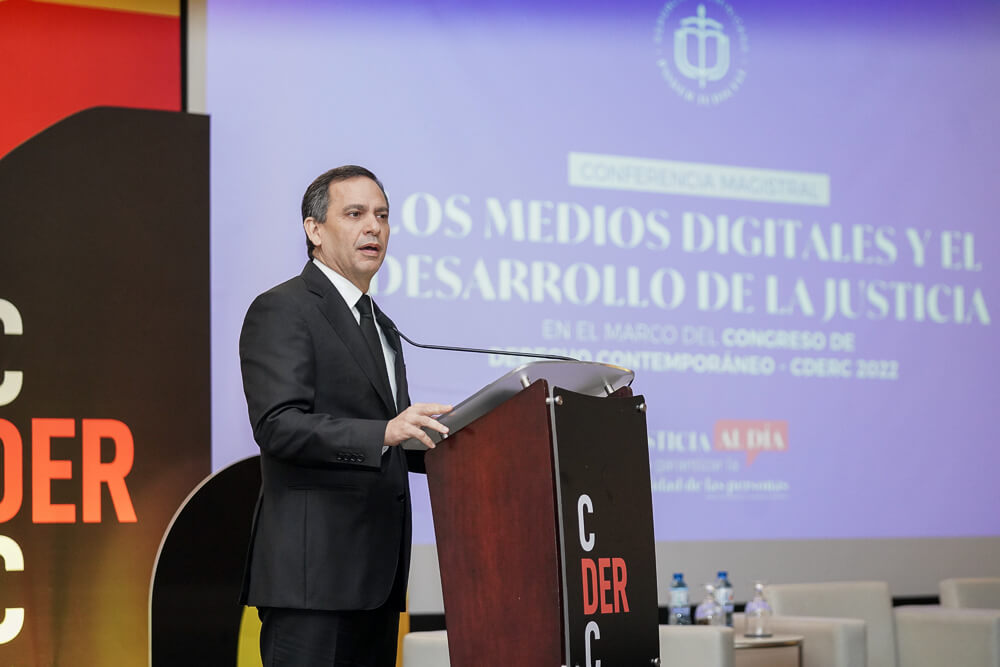
The president of the Supreme Court of Justice (SCJ) and of the Judicial Council, Justice Luis Henry Molina Peña, stated that the justice system is undergoing a significant transition based on its role in all areas of society, which, in his view, will impact the business climate, legal certainty, and the dynamism needed for the country’s present and future.
“We are achieving a system of justice that provides legal certainty for investment and business, prevents conflicts, and promotes harmonious coexistence—all of which guarantee sustainable development,” he said.
The president of the SCJ made these remarks while serving as the keynote speaker at the 2022 Contemporary Law Congress titled “The Transversality of Law,” organized by the OMG Institute.
During his presentation titled “Digital Media and the Development of Justice,” Molina Peña noted that this transformation must also extend to the way legal professionals are trained, as law schools currently focus on litigation and in-person instruction rather than conflict resolution and online learning.
“The structure of the justice system is based on a 19th-century concept designed to process cases. The judicial reform policy aims to ensure that the justice system keeps pace with the times by putting people at the center. It seeks to move beyond outdated structures so that the vision of people serving people grows stronger every day,” he said.
He noted that within the 19th-century system, one of the main problems has been judicial delays, which he described as a threat to the very purpose of the administration of justice.
He revealed that over the past three years, the SCJ has been working to reduce the backlog, and thanks to the efforts of judges and court staff, the high court has managed to reduce the backlog in cases to nearly zero.
“In January 2022, the First Chamber of the SCJ had 993 cases; now there are only 311, and we hope that by the end of the year, there will be none. The Second and Third Chambers had 110 and eight cases, respectively, that had been pending for more than six months; today, there are only 18 and 7, and we hope that by the end of the year, there will be none,” he emphasized.
He stated that, thanks to the intensive use of technology, the new judicial culture of zero backlog is having an impact on the country’s other courts, offering greater safeguards to all parties.
He said that, thanks to the enactment of the Digital Media Use Act, the Judiciary is working toward a connected justice system—one with a functional, efficient, and accessible infrastructure—that meets the needs of today’s society, offers alternatives to the most vulnerable, and is free, responsive, and reliable.
 Español
  English
  Français
  Italiano
  Deutsch
  Português do Brasil
  Polski
  Русский